Trademark notice: BRITA®, 3M®, Everpure® are registered trademarks of their respective owners. Names appear here only for fair, informational comparison and do not imply endorsement. Specs and performance should be verified with official documentation and third-party certifications.
Copyright © 2025 Explore Advanced Materials. All rights reserved. All content, images, and materials on this site are protected by copyright and may not be reproduced, copied, or used for any commercial purpose without written permission.
Table of contents
- Introduction: What PFAS are, health risks, and why home treatment still matters
- The 5 water filter formats you’ll see at home
- The 4 media types that actually do the work
- Comparison A: 5 formats × real-world performance
- Comparison B: 4 media × mechanism & PFAS behavior
- How to choose (water quality × goal × installation limits)
- Cost math: annual total cost (including RO concentrate)
- Where do PFAS go after filtering? (filters & RO concentrate)
- FAQ (8 questions, straight answers)
- Conclusion
Introduction: What PFAS are, health risks, and why home treatment still matters
PFAS (Per- and Polyfluoroalkyl Substances) are a large family of fluorinated chemicals valued for stain-, grease-, and water-repellence. Because the carbon-fluorine bond is extremely strong, many PFAS persist in the environment and the body—hence the nickname “forever chemicals.” Research links PFAS exposure with increased cholesterol, liver enzyme changes, immune effects (including reduced vaccine antibody response), pregnancy-related hypertension/preeclampsia, lower birth weight, and elevated risk of kidney and testicular cancers (evidence strength varies by compound and population). publichealth.jhu.edu
If you inetersted more, you may also check our another post: What Are PFAS? One Comprehensive Guide to “Forever Chemicals”—From Definition and 2 Classification to Health Risks, Global Regulations, and Applications.
How long do PFAS stay in the body?
Best estimates for human half-lives are roughly PFOA ~3–4 years, PFOS ~5–6 years, PFHxS ~8–9 years (ranges vary across studies). Translation: even after you cut exposure, blood levels fall slowly—which is exactly why reducing the PFAS you drink every day is worthwhile. atsdr.cdc.gov
Regulatory backdrop (U.S.):
In April 2024 the U.S. EPA finalized the first national drinking water standards for PFAS, including MCLs of 4 ppt for PFOA and 4 ppt for PFOS, plus limits for HFPO-DA (GenX), PFHxS, PFNA and a Hazard Index approach for mixtures. Utilities face multi-year monitoring and treatment timelines; check your supplier’s communications for local status. US EPA
PAA-style quick answers up front:
- Does boiling remove PFAS? No—boiling does not remove PFAS and can even concentrate them.
- What filter removes PFAS? Look for products certified for PFAS reduction under NSF/ANSI 53 (adsorption/ion exchange) or NSF/ANSI 58 (reverse osmosis, RO).
- How do I test my water for PFAS? There isn’t a true “DIY strip.” Labs use EPA Methods 533/537/537.1 for drinking water; contact your state or a certified lab.
- Is bottled water safer? Not always—PFAS have been detected in multiple bottled waters in past testing; results vary by brand and product type.
O / X
O: Treating drinking water at home can meaningfully lower your exposure.
X: Assuming “boiling” or “UV” will solve PFAS. They won’t. ( health.state.mn.us )
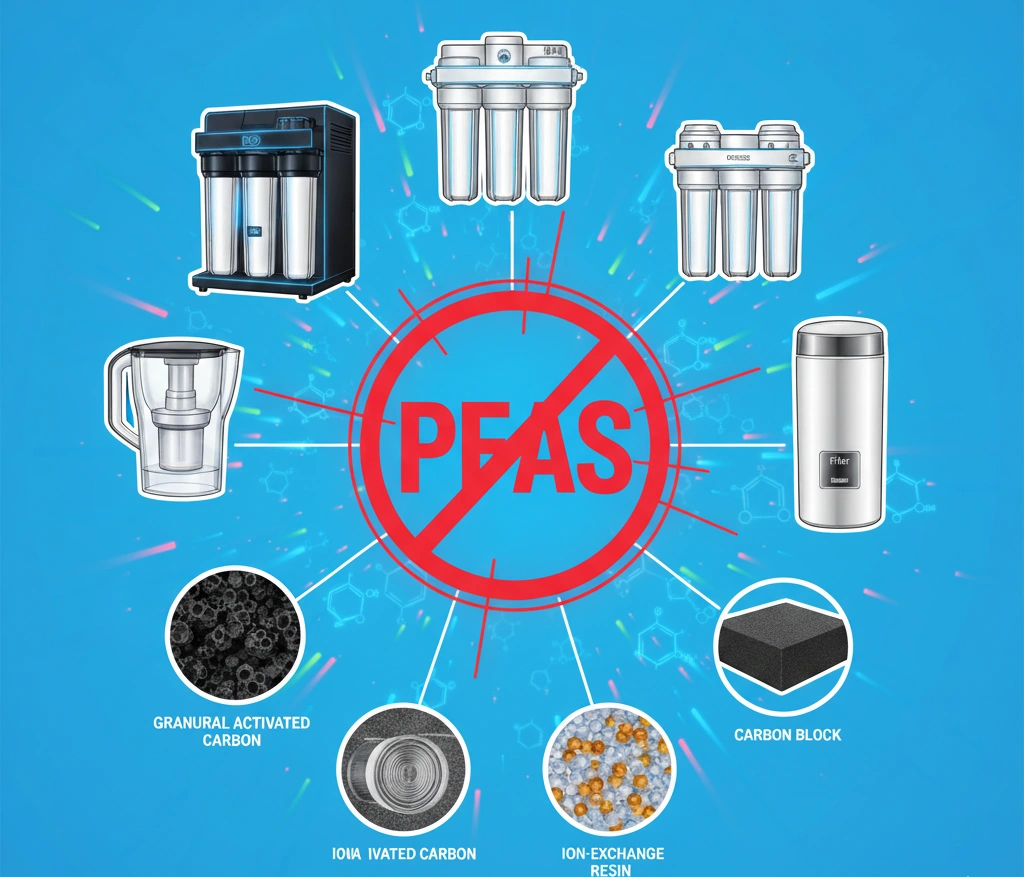
The 5 filter formats you’ll see at home (form ≠ media)
(Formats describe the device; in the next section we describe the media that actually capture PFAS.)
1) Reverse osmosis (RO) under-sink system
Typical North American stack: sediment (e.g., 20 μm) → carbon block (CTO) → carbon/softening resin (varies) → RO membrane → post-carbon. The PFAS reduction workhorse here is the RO membrane; whole-system reductions often fall in the ~90–99%+ range when properly installed and maintained. Household RO needs adequate feed pressure (commonly ~60 psi ideal; <40 psi is often insufficient; check your model), and produces a concentrate stream (often ~1:1 to 1:3 product:concentrate depending on design, pressure, and temperature). Change prefilters on schedule (months), RO membrane ~1–3 years, post-carbon 6–12 months (model and usage dependent).
2) Three-stage pre-filters only (no RO membrane)
Sediment → carbon block → carbon/softening resin without a membrane improves taste/odor, removes chlorine, and protects appliances. These stages are not a primary PFAS solution, especially for short-chain PFAS. If PFAS reduction is your goal, use RO (and/or ion exchange) or choose a NSF/ANSI 53-certified cartridge specifically listed for PFAS reduction.
3) Single cartridge (under-sink/faucet)
A single carbon block—sometimes blended with ion exchange—can reduce some PFAS if and only if the product is explicitly certified for PFAS reduction. Without certification, performance can be variable, especially on short-chain PFAS.
4) Filter pitchers (e.g., BRITA-type)
Typically granular activated carbon (GAC) + ion exchange. Great for chlorine/odor and convenience; PFAS performance varies widely by brand and model. Independent tests have found some pitchers that achieved near-100% reduction, and others with modest PFAS reduction; always confirm PFAS claims and certifications. Typical replacement: about every 4 weeks or 100–150 L (check your model).
5) Hybrid (multi-stage) stacks
Examples: RO + IX, RO + carbon post-polish, or carbon + IX in series. These aim to cover both long- and short-chain PFAS more robustly, at the cost of complexity and maintenance.
The 4 media types doing the work (what actually binds or rejects PFAS)
RO membrane: size/charge exclusion; concentrates PFAS on the reject side; strong across long- and short-chain.
GAC — Granular Activated Carbon: porous adsorption. Long-chain PFAS: mid-to-high. Short-chain: more challenging; needs time and frequent changeouts.
Carbon block (compressed): reduced channeling, higher contact; typically more consistent than loose GAC. With IX blending, short-chain performance improves.
IX — Ion exchange resin: anion exchange sites capture PFAS head groups; often stronger on short-chain than carbon alone; commonly paired with carbon or RO.
Comparison A|5 formats × real-world performance (method-level, brand-agnostic)
| Format | Typical stack | PFAS workhorse | Long-chain (PFOA/PFOS) | Short-chain (PFHxS/PFBS/GenX) | Replacement cadence (typical) | Install & efficiency | Annual cost view | Best for | O / X |
|---|---|---|---|---|---|---|---|---|---|
| RO system | Sediment → carbon → carbon/resin → RO → post-carbon | RO | High (~90–99%+) | High (more consistent) | Prefilters: months; RO: 1–3 yrs; post: 6–12 mo | Needs pressure; has concentrate (~1:1–1:3) | Include prefilters + membrane + water cost | Unknown source or low target levels | O broad & stable; X must manage concentrate & upkeep |
| 3-stage pre-filters (no RO) | Sediment → carbon → carbon/resin | none (pretreatment) | Mid (varies) | Low/variable | As above | Easy; no concentrate | Low cartridge cost, frequent swaps | Taste/odor, appliance protection | O protects downstream; X not a PFAS solution |
| Single cartridge (under-sink/faucet) | Carbon block ± IX | n/a | Mid (if certified) | Mid-to-low (variable) | 6–12 mo | Easy; no concentrate | Low entry, depends on swap rate | Entry upgrade at tap | O convenient; X verify PFAS certification |
| Pitcher | GAC + IX | n/a | Mid (brand-dependent) | Mid-to-low | ~4 weeks / 100–150 L | No plumbing | Low filter cost; frequent | Small spaces/renters | O simple; X don’t assume short-chain removal |
| Hybrid | RO + IX / RO + carbon / carbon + IX | RO/IX | High | High | Stage-by-stage | Depends on design | Highest | Tight targets | O comprehensive; X complex & costlier |
(Use NSF/ANSI 53 or 58 listings and verified test data for PFAS claims; change on schedule.) US EPA
Comparison B|4 media × mechanism & PFAS behavior (what to expect)
| Media | Full name | Mechanism | Long-chain PFAS | Short-chain PFAS | Key dependencies | Typical certification | O / X |
|---|---|---|---|---|---|---|---|
| GAC | Granular Activated Carbon | Porous adsorption | Mid–High | Mid–Low (needs time, frequent change) | Contact time, flow, organic load | NSF/ANSI 53 | O accessible; X short-chain is hard |
| Carbon Block | Compressed carbon | Higher contact, less channeling | Mid–High | Mid (better than loose GAC) | Pressure drop, flow, block quality | NSF/ANSI 53 | O stable; X still needs timely swaps |
| IX | Ion Exchange Resin | Anion exchange/adsorption | High | Mid–High (resin-dependent) | Resin type, regeneration | NSF/ANSI 53 | O short-chain helper; X cost/maintenance |
| RO membrane | Reverse Osmosis | Size/charge exclusion | High (~90–99%+) | High | Feed pressure, pretreatment, recovery ratio | NSF/ANSI 58 | O broad; X concentrate & pressure needs |
How to choose: water quality × goal × installation limits
- Know your water: Check your utility’s notices; if on a private well or you suspect PFAS, use a certified lab (EPA 533/537/537.1). US EPA
- Set a goal: Meet the EPA MCLs, or aim lower (especially if short-chain are present). US EPA
- Match the tech:
- Higher contamination / short-chain present / lower targets: RO (consider RO + IX).
- Moderate / point-of-use drinking only: Carbon block ± IX, with PFAS certification.
- Pretreatment / low concern: GAC can help, but do not rely on GAC alone for short-chain PFAS.
- Non-negotiables: NSF/ANSI 53 or 58 with PFAS reduction claims; replace cartridges/membranes on schedule. US EPA
O: Pick by certification + maintenance.
X: Buying on “max removal %” ad copy without checking certification or lifetime costs.
Cost math: annual total cost (include the “waste ratio”)
Annual Total Cost ≈ Initial hardware amortized + (sediment + carbon + resin) swaps × frequency + RO membrane swap + post-carbon + water cost (include RO concentrate ratio) + any booster pump power/maintenance. Put budget where it counts: the media that move PFAS (RO/IX) and quality pretreatment.
Where do PFAS go after filtering? Are we removing them from nature?
Short answer: NO—we’re separating and moving them.
Cartridges (GAC/carbon block/IX):
- PFAS adhere to the media. Most households dispose of spent cartridges with household trash → local waste-to-energy (incineration) or other permitted handling. The destruction efficiency for PFAS via heat treatment is still being studied; U.S. EPA’s 2024 Interim Guidance notes uncertainties for thermal and other methods. Do not cut open or rinse out used filters; bag and seal before disposal to minimize release. US EPA
RO concentrate (aka “waste” stream):
- The RO membrane retains PFAS, which concentrate in the reject line that goes to the household drain → sewer → wastewater treatment. Conventional WWTPs do not destroy PFAS; PFAS may pass through or partition to sludge. Your home system reduces what you ingest; broader environmental reduction depends on municipal treatment policies and upgrades. US EPA
O: Lower your drinking exposure; dispose of filters sealed; discharge RO concentrate to the proper drain.
X: Using RO concentrate for watering edibles or aquariums.
FAQ:
1) What water filter removes PFAS the best?
For point-of-use at the tap, reverse osmosis (NSF/ANSI 58) is the most consistently effective across long- and short-chain PFAS. Some NSF/ANSI 53 cartridges (carbon and/or ion exchange) reduce specific PFAS; verify the PFAS list and capacity.
2) Do Brita-type pitchers remove PFAS?
Sometimes—performance is brand/model-dependent. Third-party testing has found some pitchers achieving near-100% reduction, while others were modest. Always check for PFAS claims, certifications, and independent test data. Replace on schedule (~4 weeks / 100–150 L typical).
3) Does boiling remove PFAS? UV?
No and no. Boiling and UV target microbes, not fluorinated organics; they don’t break the C–F bond.
4) How do I test for PFAS in drinking water?
Use a certified lab applying EPA Methods 533/537/537.1. There is no reliable DIY strip; many states provide guidance or cost-share programs for private wells.
5) What is a “safe level” of PFAS in tap water?
In 2024, EPA set enforceable MCLs including 4 ppt for PFOA and 4 ppt for PFOS, plus limits for HFPO-DA (GenX), PFHxS, PFNA and a Hazard Index for mixtures. Some states adopt stricter levels. Check your local utility’s updates.
6) Is bottled water safer than tap water for PFAS?
Not automatically. Consumer testing has detected PFAS in many bottled waters (especially some carbonated products). The FDA reports recent results below EPA MCLs for several sampled brands, but testing is not universal. Treat your tap or choose brands that publish recent PFAS testing.
7) What pressure and temperature does a home RO need?
Many household RO systems are rated at ~60 psi and ~77°F (25°C) for their published flow/rejection; under ~40 psi often needs a booster. Always follow your model’s manual.
8) Which keywords should I look for when shopping?
Search and packaging phrases to look for include “PFAS water filter,” “NSF 53 PFAS,” “NSF 58 reverse osmosis,” “remove PFOA PFOS,” “PFAS pitcher,” “PFAS test lab,” “forever chemicals in tap water,” “GenX water filter.” These align with what users commonly query (People Also Ask/Also Search). Use them in your own notes when comparing models online.
Conclusion
Lowering risk is about reducing what you drink every day. If your top priority is both long- and short-chain PFAS, start with RO (NSF/ANSI 58)—optionally pair with IX—and keep prefilters and membranes on schedule. Single-cartridge and pitcher options can help at the tap when certified for PFAS, but don’t assume universal performance. Use annual-cost math (filters + membrane + water + power) instead of upfront price alone, and dispose of spent cartridges sealed while routing RO concentrate to the drain.
Use knowledge to change the world—starting at your kitchen sink.
Want a custom plan (your usage × hardness × target PFAS × annual cost)? Contact us and we’ll run the numbers with you.
Sources & further reading (authoritative)
- EPA — Identifying Drinking Water Filters Certified to Reduce PFAS (shopping & certification: NSF/ANSI 53, 58). US EPA
- EPA — PFAS NPDWR Treatment Fact Sheet (Apr 8, 2024): technology overview, residuals/concentrate notes. US EPA
- EPA — Technical Overview of PFAS National Primary Drinking Water Regulation (2024): MCLs and feasibility. US EPA
- ATSDR — PFAS ToxGuide: human half-life ranges and health endpoints. atsdr.cdc.gov
- Consumer Reports — How to Get PFAS Out of Your Drinking Water (2025 update): consumer shopping advice and certification codes. Consumer Reports
- NSF — PFAS in Drinking Water: consumer tips; do not boil. nsf.org
- EPA — Home Drinking Water Testing + Methods 533/537/537.1: how testing is done. US EPA
- EWG — Filter test summary (2023): variation among pitchers/POU products; check current model data before purchase. EWG
One official doorway for shoppers: EPA – Identifying Drinking Water Filters Certified to Reduce PFAS. US EPA